


How to Stop Soil Erosion on a Sloping Yard
If you have a sloping block, you’ve probably seen what heavy rain can do to exposed soil. Small channels appear, mulch moves downhill, sediment collects at the bottom of the slope and, over time, what started as a minor washout can become a much bigger erosion problem.
The key to controlling erosion is not simply covering the damaged area. You need to understand why the soil is moving in the first place.
In many cases, the problem is water.
Here’s what to look for — and some of the ways erosion can be managed.

What Causes Erosion on a Slope?
Erosion occurs when soil particles are loosened and carried away by water, wind or gravity.
On a sloping residential block, rainfall and surface runoff are often the biggest contributors.
The steeper or more exposed the slope, the easier it can be for water to gain speed as it travels downhill.
Common factors include:
Bare or recently disturbed soil
Heavy rainfall
Concentrated stormwater runoff
Water discharged onto the slope from another area
Poor drainage
Lack of established vegetation
Steep gradients
Soil types that erode easily
Landscaping or earthworks that have changed the natural flow of water
Before deciding how to repair an eroded area, try to identify where the water is coming from, how it is travelling across the site and where it eventually goes.
How to stop soil erosion on a slope:
1. Deal With Concentrated Water First
If a large amount of water is being directed onto one section of a slope, covering the soil alone may not solve the problem.
Look uphill.
Is water coming from a roof downpipe? A driveway? A neighbouring section of the property? A drainage outlet? Or is rainfall naturally concentrating into one channel?
Where appropriate, drainage may be needed to intercept or redirect water before it can continue damaging the slope.
The correct drainage solution will depend on the individual site, but the principle is simple:
Control the water as well as protecting the soil.
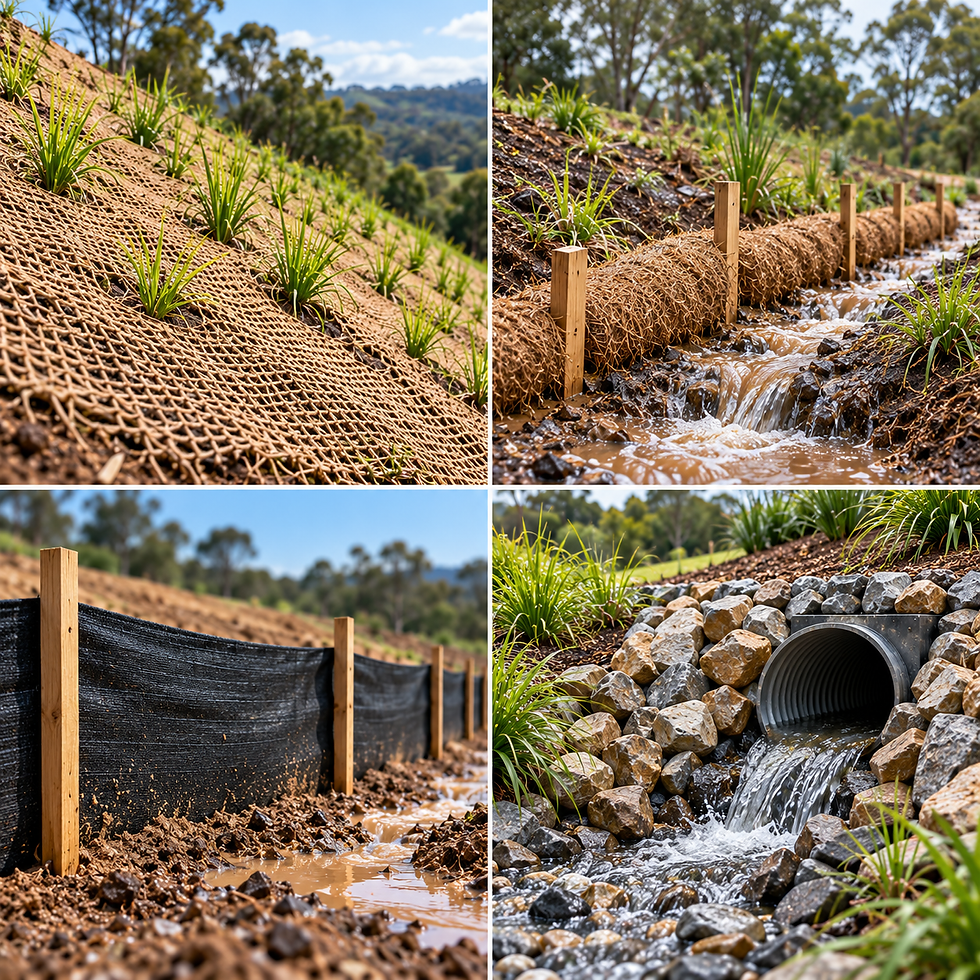
2. Protect Bare Soil With Jute Matting
Bare soil is particularly vulnerable because raindrops hit the surface directly and runoff can begin carrying loosened particles downhill.
Jute matting is a natural, biodegradable erosion-control material that can be laid over exposed soil.
Its open weave helps:
Protect the soil surface from direct rainfall
Slow surface runoff
Reduce movement of loose soil
Support seed and plant establishment
Allow vegetation to grow through the material
Jute matting is particularly useful on slopes, embankments and revegetation areas.
It needs to be installed in close contact with the soil and securely pinned. Gaps underneath the matting can allow water to concentrate and continue eroding the soil below.
3. Use Coir Logs to Slow Runoff and Trap Sediment
Where water is moving across a slope, coir logs can provide another form of erosion control.
Made from coconut fibre, coir logs are positioned and securely anchored across the direction of runoff or along the contours of a slope.
They can help:
Slow surface water
Reduce the energy of runoff
Capture moving sediment
Stabilise vulnerable areas
Support revegetation
Like jute, coir is biodegradable.
The aim is to provide protection while plants establish and their root systems gradually take over the longer-term job of stabilising the soil.
4. Sometimes Jute Matting and Coir Logs Work Together
It doesn't necessarily have to be one or the other.
They perform different jobs.
Jute matting protects a broad area of exposed soil, while coir logs create physical lines across the landscape that help slow runoff and capture sediment.
On some erosion-prone slopes, both techniques can form part of the same solution.
For example, jute matting might cover the exposed surface while coir logs are installed at strategic points across the slope to help manage moving water and sediment.
5. Establish Vegetation for Longer-Term Protection
Erosion-control products can help protect a site while vegetation establishes, but healthy plant cover is often an important part of the longer-term solution.
Plant foliage reduces the impact of rainfall on the soil surface, while root systems help bind and stabilise the soil.
The right plants will depend on the location, soil, moisture, slope and conditions of the site. For many projects, suitable native grasses, groundcovers and other locally appropriate plants can be incorporated into a revegetation plan.
The goal is to move from temporary protection to a living, stabilised landscape.
6. Don't Forget What's Happening at the Bottom of the Slope
Water doesn't disappear when it reaches the bottom.
Check where runoff and sediment are ending up.
If water is being directed towards a building, retaining wall, neighbouring property, road, stormwater system or waterway, the wider drainage design may need attention.
This is particularly important where erosion is being caused by significant or concentrated water flows.
Common Erosion-Control Mistakes
A few mistakes can make an erosion problem worse:
Treating the damage instead of the cause.If concentrated water is causing the erosion, repairing the soil without addressing the water may only provide a temporary fix.
Leaving bare soil exposed.Freshly disturbed soil can be particularly vulnerable during heavy rain.
Poorly securing erosion-control materials.Water can travel underneath loose jute or coir products and continue eroding the soil.
Forgetting about the outlet.If you're redirecting water, it needs a suitable place to discharge.
Expecting one product to solve every erosion problem.Drainage, surface protection, sediment control and revegetation perform different functions and may need to work together.
Start With Three Questions
Before buying anything, stand back and look at the whole site.
Ask:
1. Where is the water coming from?
2. How is it travelling across the property?
3. Where does it need to go?
Once you understand those three things, it becomes much easier to determine whether you need drainage, surface protection, sediment control, revegetation — or a combination of them.
Erosion-Control Supplies in Bellingen
BelloScapes Supply Co stocks a range of products for landscaping, drainage, erosion and sediment-control projects, including jute matting, coir logs, geotextile, silt fence, drainage products, pins, stakes and accessories.
Order online for collection in Bellingen, with local delivery available to the Coffs Harbour, Nambucca and Dorrigo areas.
For significant erosion, structural work, waterways or complex drainage problems, seek appropriate professional advice and check any applicable council or regulatory requirements before starting work.


Comments