


Which Erosion-Control Solution Do I Need?
Erosion control can seem straightforward until you start looking at the different products available.
Jute matting, coir logs, silt fence, drainage products and geotextiles can all play a role in managing soil and water — but they don’t all do the same job.
The right place to start isn’t with the product.
It’s with the problem you’re trying to solve.
Are you trying to protect exposed soil? Slow moving water? Stop sediment leaving a disturbed area? Or manage where water travels across the property?
In many projects, the answer may be more than one of these.
Here’s a practical guide to understanding the different roles.
Start by understanding erosion
Erosion occurs when soil is detached and moved from one place to another.
Rainfall can loosen exposed soil particles, while water flowing across the ground can carry those particles downhill.
Sloping ground, concentrated runoff and areas where vegetation has been removed can be particularly vulnerable.
Sediment control is related, but it addresses a different stage of the process.
Erosion control aims to reduce the amount of soil being detached and moved in the first place.
Sediment control aims to intercept soil particles once they have already been mobilised.
That distinction helps explain why different products are used for different purposes.
Protect soil — Jute Matting
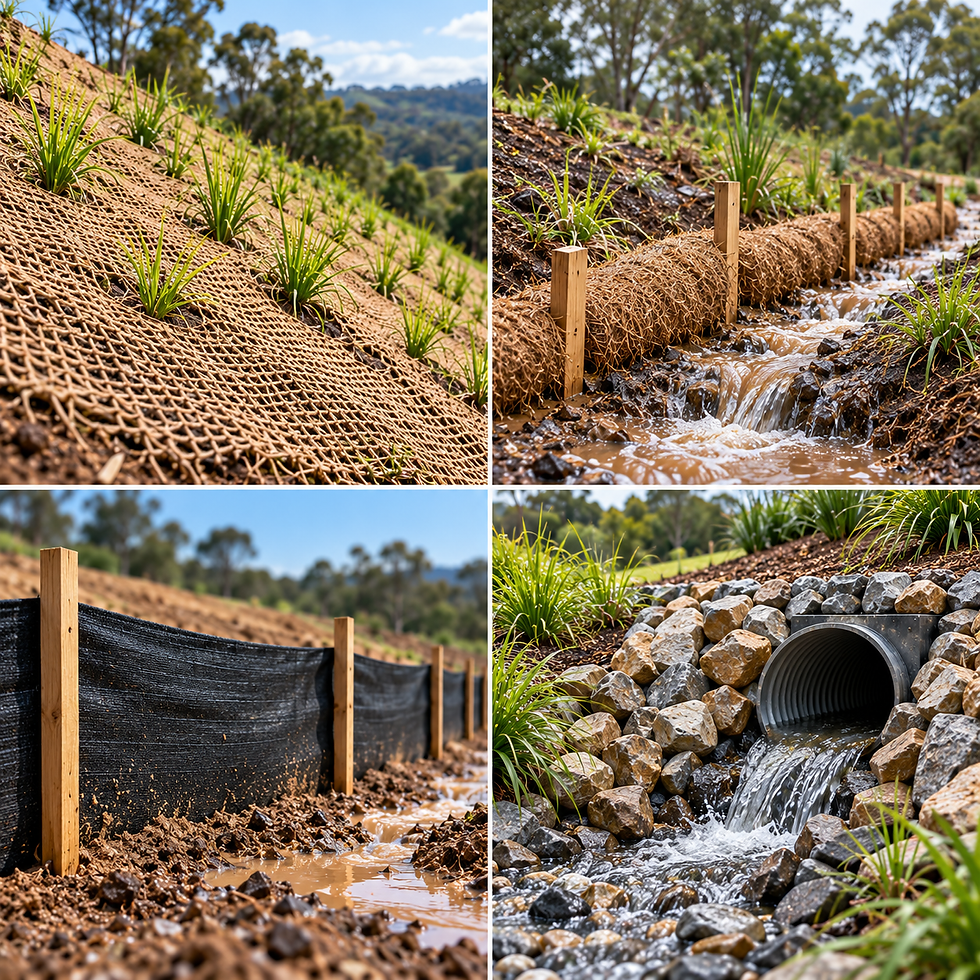
Jute matting is a natural, biodegradable open-weave material that can be installed directly over exposed soil.
Its role is primarily to help protect the soil surface while vegetation becomes established.
The matting provides some protection from direct rainfall impact and helps stabilise the surface while still allowing plants to grow through the open weave.
It can be particularly useful for applications such as:
• Revegetation projects• Landscaped slopes• Embankments• Disturbed soil awaiting vegetation establishment• Areas where additional surface protection is required
Correct installation matters.
Jute should maintain good contact with the soil and be appropriately secured. If water can simply travel underneath poorly installed matting, its effectiveness can be reduced.
Jute matting is not intended to act as a waterproof layer or replace drainage where significant water movement needs to be managed.
Its job is to help protect the soil.
Slow runoff — Coir Logs
Coir logs are cylindrical erosion-control products made from coconut fibre.
Rather than covering an entire area of soil, they can be positioned strategically to interact with moving water.
Depending on the site and application, coir logs can help slow runoff, reduce its erosive force and encourage sediment carried by the water to settle.
They may be used across slopes, around disturbed areas, as part of revegetation works or in appropriate drainage and erosion-control applications.
Because coir is a natural fibre, these products can also suit projects where vegetation establishment and integration with the surrounding landscape are important.
Placement is critical.
Water follows gravity, so a coir log positioned somewhere runoff never reaches won’t achieve much. The site needs to be assessed to understand where water is travelling before deciding where erosion-control measures should go.
Capture sediment — Silt Fence
Silt fence has a different job again.
It is primarily a sediment-control measure used to help intercept sediment-laden runoff leaving disturbed soil.
A typical silt fence uses woven geotextile supported by stakes and installed so runoff encounters the barrier before leaving the controlled area.
The water is slowed while sediment can settle behind the fence.
Silt fence is commonly associated with construction and earthworks sites, but the principle is relevant to many situations where disturbed soil needs to be contained.
Correct installation is particularly important.
The bottom of the fabric needs to be appropriately secured so sediment-laden water cannot simply flow underneath it, and the fence needs to be located according to how water actually moves across the site.
A silt fence is not designed to function as a dam or manage large volumes of concentrated water.
Its job is to help capture sediment.
Manage water — Drainage
Sometimes erosion is a symptom of a broader water-management problem.
If large amounts of water are repeatedly travelling across a particular area, simply protecting the soil may not address the source of the issue.
This is where drainage may become part of the solution.
A well-considered drainage system generally needs to do three things:
Collect → Carry → Appropriate discharge
First, water needs to be collected where appropriate.
Then it needs to be carried through a suitable drainage system.
Finally, it needs somewhere appropriate to discharge.
That final step is important.
Moving water away from one part of a property only to create erosion, waterlogging or another problem elsewhere isn’t effective water management.
Where does geotextile fit?
Geotextile can play an important supporting role in many drainage and landscaping applications.
A suitable permeable geotextile can allow water to pass through while helping filter fine soil particles and maintain separation between natural soil and drainage aggregate.
That separation helps reduce the mixing of different material layers.
Geotextile isn't a waterproof barrier, and it isn't an erosion-control solution for every situation.
Its function depends on the application and the type of geotextile being used.
Do I need more than one erosion-control product?
Quite possibly.
Real sites don’t always present one neat problem at a time.
Imagine a newly landscaped slope with exposed soil and significant runoff during heavy rain.
The project might need measures to:
• Protect the exposed soil surface• Slow water moving down the slope• Capture sediment before it leaves the disturbed area• Manage concentrated water appropriately• Establish vegetation for longer-term soil stability
That could involve several different products working together rather than relying on one product to do everything.
A simple way to choose
Before deciding what to use, identify what you actually need to achieve.
If the problem is exposed soil:
Consider soil protection and revegetation measures such as jute matting.
If the problem is runoff moving across vulnerable ground:
Consider how the flow can be slowed and managed. Coir logs may form part of an appropriate erosion-control strategy.
If sediment is leaving disturbed ground:
Consider sediment-control measures such as correctly installed silt fence.
If concentrated water is creating the problem:
Investigate where the water comes from, where it travels, where it collects and where it can appropriately discharge before deciding on drainage.
The important point is that these aren't interchangeable solutions.
Think about what happens after the next downpour
Erosion-control measures should be planned for wet conditions, not just how a site looks on a dry day.
When assessing your property or project, ask:
Where will rainwater come from?
Which direction will it travel?
Will it become concentrated anywhere?
Which areas of soil are exposed?
Where could sediment travel?
Where can collected water appropriately discharge?
What will protect the soil while vegetation establishes?
Those questions can help you identify the actual problem before choosing a product.
Different problems need different solutions
There isn’t one erosion-control product that does everything.
Jute matting can help protect exposed soil.
Coir logs can help slow runoff and support erosion-control strategies.
Silt fence can help capture sediment leaving disturbed areas.
Drainage can help manage water where appropriate.
Geotextile can provide filtration and separation within suitable applications.
The best solution starts with understanding how soil and water behave on your particular site.
Protect the soil. Follow the water. Then choose the solution.
Erosion-control supplies in Bellingen
BelloScapes Supply Co supplies erosion and sediment control, drainage, geotextile and landscaping products for tradies, landscapers and DIY projects.
Our range includes products for soil protection, revegetation, sediment control, drainage, filtration and separation.
Collect in Bellingen, with local delivery available to the Coffs Harbour, Nambucca and Dorrigo areas.


Comments