


How to Improve Drainage Around Your Home and Garden
Poor drainage can turn a beautiful garden into a soggy mess, leave lawns waterlogged, and contribute to problems around retaining walls, paths, and landscaped areas.
The good news is that many residential drainage problems can be improved by managing where water collects and giving it an effective path away from the problem area.
Products such as geotextile filter fabric and subsoil drainage systems can play an important role in creating a drainage solution that continues working below the surface.

How do I know if I have a drainage problem?
Some drainage problems are obvious after heavy rain. Others develop gradually.
Common signs include:
Water pooling in the garden after rain
Persistently soggy or boggy lawn
Areas where plants struggle because the soil remains wet
Water collecting beside retaining walls
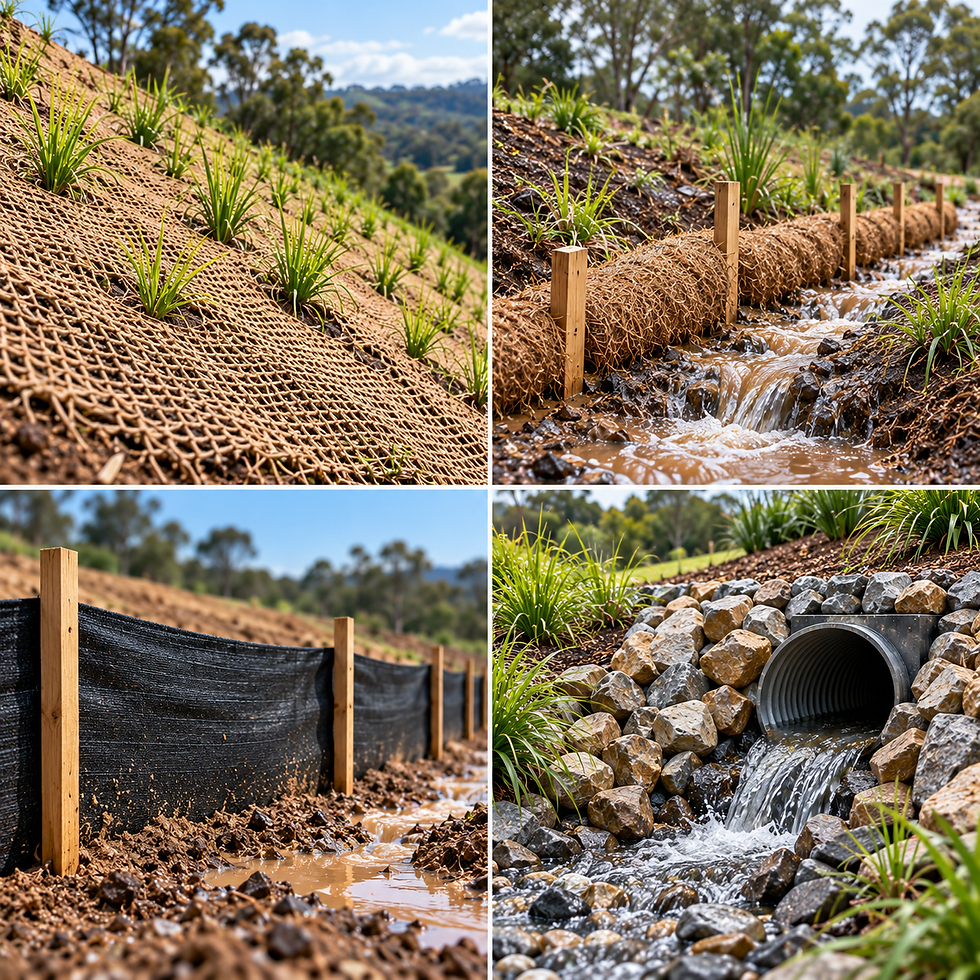
Erosion or soil washing away
Muddy pathways or garden areas
Gravel areas becoming contaminated with soil
Water repeatedly appearing in the same low points
Here in the Bellingen region, periods of substantial rainfall can make effective drainage particularly important for both residential and commercial properties.
Why does water keep pooling in my garden?
Water naturally moves towards lower areas, so the shape and slope of your property can have a major effect on where it collects.
Soil type matters too. Some soils drain relatively quickly, while others retain water.
Compaction, landscaping changes, retaining walls, driveways and other construction can also alter the way water moves across and beneath a property.
Sometimes the solution is relatively straightforward. In other cases, persistent water can indicate a larger drainage issue that requires professional assessment.
What is subsoil drainage?
Subsoil drainage is designed to collect and move water beneath the ground surface.
A drainage system may include a drainage channel or trench, drainage material such as aggregate, a drainage product and geotextile filter fabric.
Rather than waiting for water to sit on the surface, the system provides a pathway through which subsurface water can be collected and directed towards an appropriate discharge point.
Why is geotextile used in drainage?
One of the challenges with a gravel drainage system is keeping fine soil particles out of the drainage material.
Over time, soil migration can contaminate the aggregate and reduce the space available for water to move through.
A suitable nonwoven geotextile filter fabric can provide separation and filtration.
Water is able to pass through the permeable fabric while the geotextile helps prevent surrounding soil from migrating into the drainage layer.
BelloScapes Supply Co. stocks Bidim Green Filterwrap for filtration and separation applications.
With several roll widths available, it can be used for projects ranging from relatively narrow drainage applications to larger landscaped areas.
What is Megaflo Green drainage?
For projects requiring a purpose-designed subsoil drainage product, Megaflo Green offers an alternative to conventional round drainage pipe.
BelloScapes stocks Megaflo Green 170 in 25-metre lengths, together with compatible fittings for building a complete drainage run.
These include:
Megaflo 170 T & Y Fittings – for branching or intersecting drainage runs.
Megaflo 170 End Caps – for terminating the closed end of a drainage run.
Megaflo 170 End Outlet Fittings – for creating an outlet at the end of the drainage system.
Can Megaflo be used around a home?
Subsoil drainage systems have applications well beyond large civil projects.
Depending on site conditions and the drainage design, they may form part of residential projects involving:
Landscaped areas
Retaining walls
Driveways
Garden drainage
Wet areas of a property
Subsurface water management
The important part is understanding where the water is coming from and where it can safely go.
Installing drainage without an appropriate outlet simply moves the problem from one part of the trench to another.
How can I improve drainage in a waterlogged garden?
Imagine a section of backyard that becomes saturated every time there is prolonged rain.
A drainage solution might involve creating a drainage run through or beside the affected area, using appropriate drainage material and filtration to collect subsurface water and direct it towards a suitable outlet.
Geotextile can help separate the surrounding soil from the drainage aggregate, while a product such as Megaflo can provide a pathway for the collected water.
The exact design will depend on the property, levels, soil and where the water can legally and safely be discharged.
What about drainage behind a retaining wall?
Water management is particularly important around retaining walls.
Water accumulating behind a wall can create additional pressure, so drainage is generally considered as part of the wall's overall design.
Geotextile may be used to help separate soil from drainage aggregate, while an appropriate subsoil drainage system helps collect and remove water.
For structural or engineered retaining walls, always follow the specified drainage design rather than treating drainage as an optional extra.
Can I install garden drainage myself?
Some smaller residential drainage and landscaping projects may be suitable for experienced DIYers.
Before starting, however, make sure you understand:
Where is the water coming from?
You need to solve the actual problem rather than simply hide the water underground.
Where will the water go?
A drainage system requires an appropriate outlet.
Are there underground services?
Always establish what's below the area before excavating.
Does the work require professional advice or approval?
Larger drainage works, retaining walls and projects affecting stormwater or neighbouring properties may require professional design or approval.
If you're uncertain, getting advice before digging can save a lot of expensive rework later.
How much drainage material will I need?
Start by measuring the total length of your proposed drainage run.
Megaflo Green 170 stocked by BelloScapes is supplied in 25-metre lengths.
For example, a drainage run slightly longer than 50 metres would require three lengths rather than two.
You'll also need to consider the configuration of the system and whether you require branches, end caps or outlet fittings.
We're developing the BelloScapes Product Calculator to help customers estimate quantities for drainage, geotextile and other products based on their project measurements.
Where can I buy drainage supplies in Bellingen?
BelloScapes Supply Co. stocks specialist drainage, geotextile, erosion-control products, fixings and accessories locally in Bellingen NSW.
Our range is available to homeowners and DIY customers as well as landscapers, builders, earthmovers and other trades.
You can order online and arrange click & collect in Bellingen, with local delivery to the Dorrigo and Coffs Harbour regions also available.
Start with the problem, not the product
If your garden is constantly wet, simply adding gravel or digging a trench isn't necessarily going to solve it.
A good drainage solution starts by understanding how water is moving across and through your property.
Once you understand the problem, products such as Bidim Green Filterwrap and Megaflo Green can become part of an effective solution.
For technical specifications and installation requirements, refer to the manufacturer's technical information. For larger or complex drainage issues, seek appropriate professional advice.


Comments